How Dog Behaviour Develops: Breeder to Home
Dogs, Behaviour, Training, Puppy Development
How Behaviour Is Formed in Dogs: From Breeder to Family Home
Understanding how a dog’s behaviour is formed is the key to raising a confident, well‑mannered companion. From genetics and early experiences to breeder influence, socialisation and everyday handling, many pieces come together to shape the dog who eventually curls up on your sofa. For more on early development, you might also like our guide on puppy socialisation timelines.
“Behaviour is the result of an ongoing conversation between genes and environment; neither acts alone.”
— Adapted from the perspective of veterinary behaviourist Dr. Karen Overall, Manual of Clinical Behavioral Medicine for Dogs and Cats
What Do We Mean by “Behaviour” in Dogs?
Behaviour is simply what a dog does and how it responds to the world around it. Barking at the door, settling on a bed, greeting visitors politely, guarding a toy, chasing wildlife, or relaxing in busy environments – all of these are behaviours. Some are influenced strongly by genetics, others by learning and experience, and most are a blend of both. If you’re new to this topic, our article on understanding canine body language is a helpful companion read.
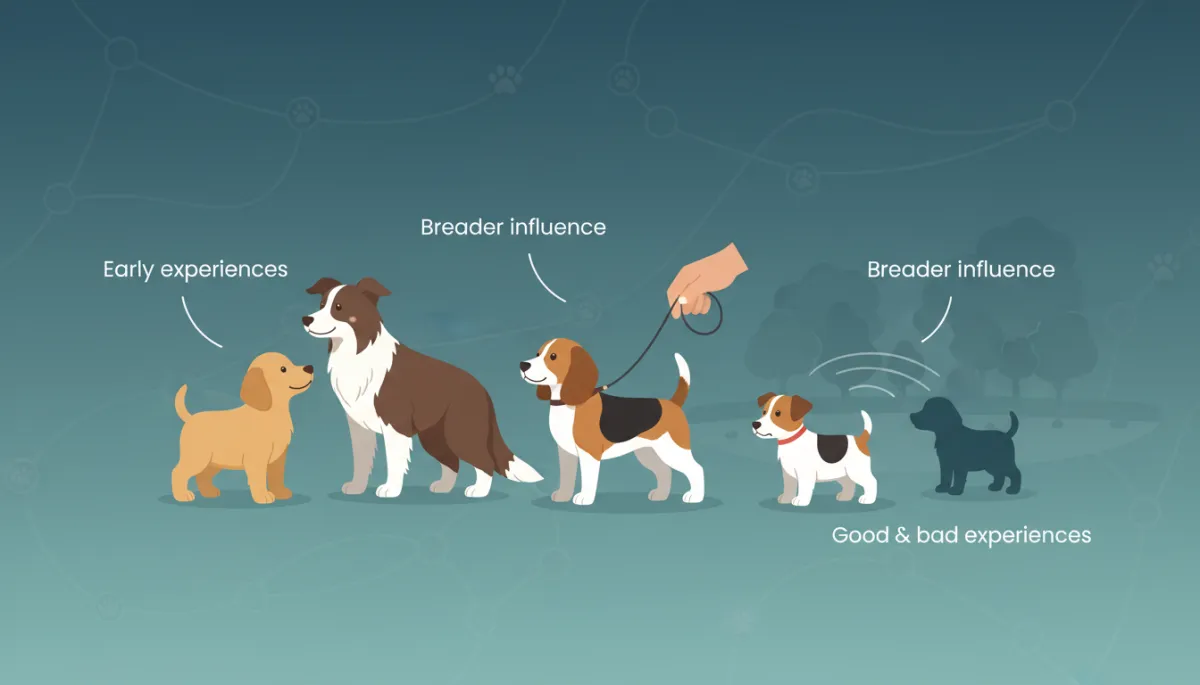
Modern canine science shows that behaviour is shaped by a combination of nature and nurture: inherited traits, early development, the breeder’s practices, the new home environment, training methods and the dog’s ongoing experiences throughout life. No single factor acts in isolation, which is why two puppies from the same litter can grow up quite differently depending on where they land.
📌 Research spotlight: Long‑term studies such as the UK’s Dogslife project and work published in journals like Applied Animal Behaviour Science consistently highlight how early environment and ongoing training interact with genetics to shape adult behaviour.
How Behaviour Is Formed: Nature and Nurture Working Together
To understand how behaviour is formed in dogs, it helps to think of three overlapping layers:
Genetic blueprint – the inherited tendencies passed down from parents and ancestors (for example, herding instinct, guarding tendencies, sociability, sensitivity to sound).
Early development – experiences from before birth to around 16 weeks, including the breeder’s care, maternal behaviour and early socialisation. This period has a powerful and long‑lasting impact.
Ongoing learning – everything that happens in the dog’s life after it leaves the breeder: training, daily routine, good and bad experiences, health, and the way people respond to its behaviour.
📌 Key takeaway: Behaviour is not fixed at birth. Genetics set the stage, but experiences – especially in puppyhood – decide how that potential is expressed. For practical ideas on what to focus on in the first months, explore our confident puppy checklist.
“Heritability estimates tell us that genes matter, but they never tell the whole story; environment and learning remain crucial.”
— Based on findings from Serpell & Duffy’s work with the C‑BARQ temperament database
Early Experiences: Why the First Weeks Matter So Much
Early experiences begin before a puppy is even born. The mother’s stress levels, health, and environment during pregnancy can all influence how reactive or resilient her puppies are. After birth, the period up to around 16 weeks – particularly the socialisation window from roughly 3 to 12 weeks – is when puppies are most open to forming positive associations with the world.
During these weeks, puppies are learning what is safe and what is scary. Gentle handling, exposure to everyday household sounds, meeting a range of people, and age‑appropriate play all help build a puppy who is curious and confident rather than fearful. Puppies who grow up in a quiet shed or kennel with little human contact often find normal life in a busy UK household overwhelming later on. For a step‑by‑step plan, see our post on the first four weeks with your puppy at home.
📌 Research spotlight: Classic work by Dr. John Paul Scott and John Fuller, and later studies summarised by the American Veterinary Society of Animal Behaviour, show that puppies deprived of early social contact are significantly more likely to develop fear and avoidance behaviours.
💡 Pro tip: When choosing a puppy, ask the breeder to show you videos of the litter at different ages so you can see what they have been exposed to in those crucial early weeks. You can find a handy list of questions to ask in our responsible breeder checklist.
Parental Influence: More Than Just Looks
The behaviour of a puppy’s parents – particularly the mother – has a major impact on the behaviour of the puppies. This happens in several ways:
Genetics: Traits such as sociability, fearfulness, boldness, sensitivity to noise, and tendency to guard resources all have a heritable component. Nervous or aggressive parents are more likely to produce puppies with similar tendencies, especially if those traits are reinforced by poor handling.
Modelling: Puppies watch their mother closely. A calm, friendly dam who greets visitors and copes well with everyday life gives her puppies a reassuring example. A stressed, snappy or shut‑down mother can pass on her anxieties through her behaviour as well as her genes.
Maternal care: How attentive the mother is – how she cleans, feeds and comforts her litter – influences how well puppies learn to regulate their emotions. Inconsistent or rough care can contribute to more reactive behaviour later on.
Responsible breeders do not breed from dogs with poor temperaments, even if they look impressive or have show or working titles. They understand that good temperament is just as important as good health when it comes to producing dogs who can live happily in modern homes. If you’re comparing potential litters, our article on assessing temperament in parent dogs can support your decision‑making.
“Selecting for sound temperament is one of the most powerful welfare tools breeders have.”
— Paraphrased from guidance by the UK Kennel Club and leading veterinary behaviourists
Breeder Influence: Setting Puppies Up for Success or Struggle
The breeder plays a central role in shaping a puppy’s early behaviour. Long before a new owner arrives, the breeder is making decisions that affect every aspect of the puppy’s future – from which parents to use, to how the litter is raised and how each puppy is matched to a home.
How Puppies Are Treated With the Breeder
Ethical breeders treat their puppies as future family members, not just commodities. This includes:
Clean, comfortable housing in the home or in a well‑managed area where puppies can see, hear and smell normal life – kettles boiling, the television, the hoover, visitors coming and going.
Gentle, regular handling from different people, so puppies learn that human touch is safe and pleasant. This can include being briefly picked up, examined, having paws and ears touched, and being calmly rewarded for staying relaxed.
Age‑appropriate challenges, such as different floor surfaces, low steps, safe tunnels or wobble boards, and short car rides. These help puppies become adaptable and resilient.
In contrast, puppies raised in cramped pens, sheds or barns with little human interaction often arrive in their new homes under‑socialised and anxious. They may struggle with house‑training, handling, separation, and normal household noise, and can be more prone to fear‑based behaviour problems later on.
📌 Research spotlight: A 2013 study in the Journal of the American Veterinary Medical Association found that dogs sourced from high‑volume commercial breeders were significantly more likely to show fear and aggression than dogs from small‑scale, home‑raised litters.
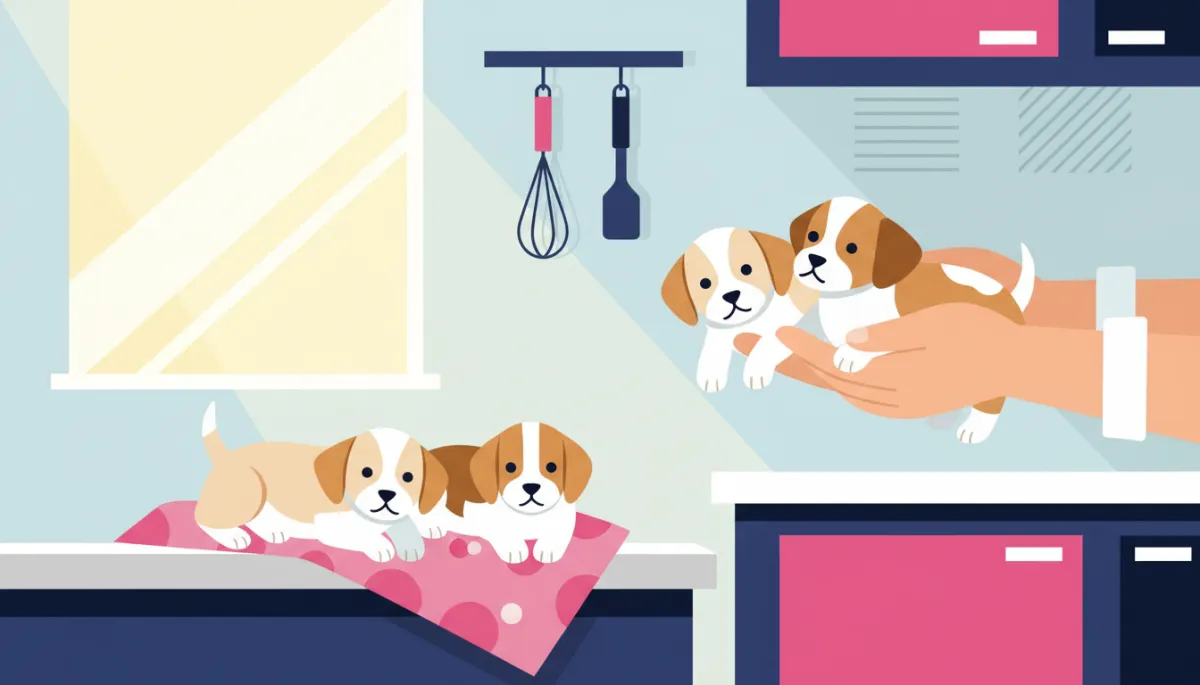
Thoughtful early handling at the breeder lays the groundwork for calm, confident adult dogs.
Breeder‑Led Socialisation and Early Learning
Good breeders follow structured socialisation plans. Many use programmes that introduce puppies to novel sights, sounds and surfaces in a controlled, positive way. They may play recordings of traffic, trains and fireworks at low volume, introduce children and adults of different ages, and allow puppies to explore safe indoor and outdoor spaces at their own pace, always pairing new things with treats or gentle praise.
This work means that when the puppy arrives in a new home, it has already learned that new does not have to mean frightening. That foundation makes it far easier for owners and trainers to continue the socialisation process without overwhelming the puppy. For more on what to do once your puppy is home, read our piece on creating a puppy socialisation plan.
Socialisation: Building a Dog Who Can Cope With the Real World
Socialisation is about far more than simply “meeting lots of dogs”. It is the process of gently introducing a puppy to the people, animals, environments, sounds and experiences it is likely to encounter in everyday UK life, and making sure those encounters are positive or at least neutral, never overwhelming or frightening.
Effective socialisation is:
Planned: Thoughtfully exposing the puppy to buses, cyclists, children, people in hi‑vis, the vet practice, the groomer, different floor surfaces, lifts, and so on, rather than leaving it to chance.
Positive: Pairing new experiences with food, play and calm reassurance. If the puppy looks unsure, giving it space rather than forcing it closer “to get used to it”.
Controlled: Avoiding chaotic puppy parties or busy dog parks where rough play, bullying or frightening experiences can occur before the puppy is ready to cope.
⚠️ Warning: Flooding a puppy with too many intense experiences too quickly can backfire, creating anxiety rather than confidence. Quality of exposure matters more than quantity. If you’re unsure where to start, our socialisation ideas for urban dogs offers gentle, real‑life examples.
“Behaviour problems in adult dogs are often rooted in inadequate or inappropriate socialisation during the sensitive period.”
— Summary of recommendations from the American Veterinary Society of Animal Behavior position statement on puppy socialisation
Good and Bad Experiences: How Dogs Learn From Consequences
Dogs are constantly learning from the consequences of their actions. If a behaviour leads to something the dog finds rewarding, it is more likely to be repeated. If it leads to something unpleasant or frightening, the dog may avoid that situation or react defensively in future.
The Power of Positive Experiences
Positive experiences – such as being rewarded for coming when called, calmly watching the world go by from a café table, or being gently handled at the vet – teach dogs that people and the wider world are safe. They also build trust between dog and owner. Over time, this trust becomes the foundation for reliable behaviour in distracting or stressful situations. For practical training ideas, see our article on reward‑based dog training basics.
📌 Research spotlight: Numerous studies reviewed in the journal Animals report that dogs trained with reward‑based methods show fewer fear and aggression problems than those trained with punishment‑heavy approaches.
The Lasting Impact of Negative Experiences
Negative experiences can leave deep marks, especially if they happen during key developmental stages. Being attacked by another dog, frightened by rough handling, or punished harshly for normal puppy behaviour can all contribute to fear, reactivity or aggression later on. Dogs do not understand that a person is “just telling them off” – they only feel unsafe, and may learn that the best defence is to growl, snap or avoid.
This is why modern, ethical trainers and behaviourists strongly recommend reward‑based training methods and avoiding tools or techniques that cause pain, fear or intimidation. Calm guidance and consistency are far more effective than punishment in shaping reliable, happy behaviour. If you’re dealing with worry, you may find our post on helping reactive dogs feel safe reassuring.
“Punishment‑based training methods are associated with increased fear, anxiety, and aggression in dogs.”
— Reflecting conclusions from peer‑reviewed studies by Hiby et al. and Vieira de Castro et al.
Breed and Behaviour: What Genetics Can – and Cannot – Tell You
Breed absolutely plays a role in behaviour, but it is not a guarantee of how any individual dog will act. Breeds were developed for particular jobs – herding, guarding, hunting, retrieving, companionship – and those original purposes still influence the instincts and tendencies we see today.
Herding breeds (such as Border Collies) often have strong chase and control instincts, high energy and a need for mental stimulation.
Guarding breeds (such as German Shepherds) may be naturally watchful and more suspicious of strangers, requiring careful socialisation and responsible management.
Gundogs (such as Labradors and Spaniels) tend to be people‑oriented and biddable, but can also be excitable and mouthy if their needs are not met.
However, there is huge variation within every breed. A well‑bred, well‑raised dog of a so‑called “difficult” breed may be far easier to live with than a poorly bred, under‑socialised dog of a traditionally “easy” breed. Breed gives you a useful starting point when thinking about exercise, mental stimulation and training, but it does not replace careful assessment of the individual dog in front of you. Our article on choosing the right dog for your lifestyle explores this in more depth.
📌 Research spotlight: Large‑scale genetic studies, including research published in Science in 2022, suggest that while breed explains some behavioural tendencies, individual variation and environment account for much of what we see day to day.
Other Key Influences on Behaviour Throughout Life
Health and Pain
Physical health has a profound effect on behaviour. Dogs in pain may become withdrawn, irritable, or aggressive when touched. Hormonal changes, neurological issues, sensory loss (such as deafness or blindness) and chronic illness can all alter how a dog behaves. Any sudden or unexplained change in behaviour should always prompt a thorough veterinary check before assuming the problem is purely “training”.
💡 Pro tip: Behaviour problems are often pain problems in disguise. Many behaviour texts, including those by veterinary behaviourist Dr. Daniel Mills, emphasise ruling out medical causes before starting any training plan.
Routine, Environment and Lifestyle
Dogs thrive on predictable routines and environments that meet their physical and emotional needs. Lack of exercise, boredom, long‑term confinement, inconsistent rules, or chaotic households can all lead to unwanted behaviours such as destructiveness, barking, over‑arousal or anxiety. Providing appropriate outlets – walks, sniffing, play, training games and rest – helps dogs behave well because their needs are actually being met. For inspiration, you might enjoy our blog on enrichment activities for family dogs.
Human Attitude and Handling Style
The way people think about dogs directly shapes how they treat them. If a dog is seen as stubborn, dominant or “doing it on purpose”, it is more likely to be punished. If it is viewed as confused, anxious or under‑trained, it is more likely to receive patient guidance. Over time, dogs handled with kindness and clarity develop very different behaviour patterns to those who are shouted at, yanked or frightened into compliance.
💡 Pro tip: Ask yourself, “What is this behaviour for from my dog’s point of view?” rather than “How do I stop it?” That shift in mindset leads to more humane and effective solutions. If you’d like help reframing common struggles, take a look at our article on rethinking common dog behaviour problems.
“When owners understand the emotional needs behind behaviour, welfare and relationships improve dramatically.”
— Echoing themes from modern canine welfare research and position statements by international behaviour organisations
Bringing It All Together: Raising a Behaviourally Healthy Dog
When you bring a puppy or adult dog into your life, you are not starting from a blank page. Their behaviour has already been influenced by parental temperament, breeder choices and early experiences. However, what you do next still matters enormously. Behaviour continues to be shaped every single day through socialisation, training, routine and the quality of your relationship with your dog.
Choose breeders who prioritise health, temperament and early socialisation, and who are open about how their puppies are raised.
Continue careful, positive socialisation at home, going at your dog’s pace and avoiding overwhelming situations.
Use reward‑based training to teach the behaviours you want, rather than focusing only on stopping the ones you do not like.
Provide appropriate exercise, mental stimulation and rest, tailored to your dog’s breed type and individual personality.
Seek help early from a qualified, force‑free trainer or behaviourist if you notice worrying signs, rather than waiting for problems to escalate.
Ultimately, behaviour is not just about obedience commands or party tricks. It is about how safe, understood and supported your dog feels in a human‑centred world. When we respect the powerful influence of genetics, early experiences, breeder practices, socialisation, good and bad experiences, and ongoing care, we are far better placed to raise dogs who can truly thrive alongside us. To continue building that understanding, you may also enjoy our overview of signs of a happy, relaxed dog at home.

